- China Insights Weekly | AI, Innovation, Business & Tech in China
- Posts
- China’s LLMs IPO 🧠 Nvidia Picks Chinese Lidar 🚗 BYD & Xiaomi Crack Top 4 ⚡
China’s LLMs IPO 🧠 Nvidia Picks Chinese Lidar 🚗 BYD & Xiaomi Crack Top 4 ⚡
China Insights Weekly for January 12. Unpacking China’s economic and technological advances.


Tomas Kucera & Yereth Jansen
January 12, 2026

In partnership with

Welcome back to China Insights Weekly. Here are some of the key highlights for this week’s edition:
Shanghai stocks hit a decade high, insurers and tech lead gains
China dominates humanoid robots, vendors take most global shipments
Clone-hybrid rice breaks yield limits, seed traits now self-replicate
Supercritical CO₂ power goes commercial, waste heat turns into grid power
🚀 Headlines
Zhipu AI soars in Hong Kong IPO making it world's first LLM to go public, MiniMax follows day later (link, link)
Zhipu AI, a Chinese startup and the world's first major large language model (LLM) firm to go public, saw its shares surge 12.4% on its first day of trading in Hong Kong, closing at HKD 130.60 (USD 16.76) per share. This brought its market capitalization to HKD 57.5 billion. The company's initial public offering (IPO) was heavily oversubscribed, with Hong Kong investors oversubscribing 1,159.5 times and international investors 15.3 times, raising over HKD 4.3 billion (USD 552 million). Zhipu AI plans to invest 70% of the net IPO proceeds in R&D for general-purpose AI models and 10% in optimizing its Model-as-a-Service platform.
A day later, on January 9th, MiniMax, an AI firm backed by Chinese game developer MiHoYo, experienced a robust debut on the Hong Kong Stock Exchange, with shares surging over 70% and briefly pushing the company's market capitalization above HKD 90 billion (USD 11.5 billion). The company, founded by former SenseTime vice president Yan Junjie, priced its IPO at HKD 165 per share, raising HKD 5.54 billion (USD 710 million) in gross proceeds. The IPO was significantly oversubscribed, with the Hong Kong public offering oversubscribed 1,837 times and the international placement covered 37 times. The company, which focuses on foundation models and AI applications, plans to use IPO proceeds to upgrade large language models and develop AI-native products.
With the MiniMax IPO, five artificial intelligence companies from Shanghai, including Biren Technology, MetaX, Insilico Medicine, and Iluvatar CoreX, which span fields from graphics processing units to AI-powered drug discovery, have completed their initial public offerings in one month.

Zhipu AI became the world’s first major LLM to list on the stock market
US semiconductor giant Nvidia chooses China’s Hesai for lidar sensors in Hyperion autonomous driving platform (link)
Hesai Group, the world's largest maker of vehicle lidar sensors, has partnered with Nvidia to supply lidar sensors for Nvidia's Drive Hyperion platform, designed for level 4 (L4) autonomous driving. Hesai's sensors, ready for mass production, will support a platform that includes system-on-a-chip processors and a safety-certified operating system. This collaboration is set to accelerate Hesai's global expansion. The company plans to double its production capacity to 4 million units in 2026 to meet demand. The partnership and production expansion come amidst China's approval of mass production for L3 vehicles and the potential for 300,000 driverless taxis with L4 capabilities operating in China's top-tier cities by 2030.
A big 2026 starts now

Most people treat this stretch of the year as dead time. But builders like you know it’s actually prime time. And with beehiiv powering your content, world domination is truly in sight.
On beehiiv, you can launch your website in minutes with the AI Web Builder, publish a professional newsletter with ease, and even tap into huge earnings with the beehiiv Ad Network. It’s everything you need to create, grow, and monetize in one place.
In fact, we’re so hyped about what you’ll create, we’re giving you 30% off your first three months with code BIG30. So forget about taking a break. It’s time for a break-through.
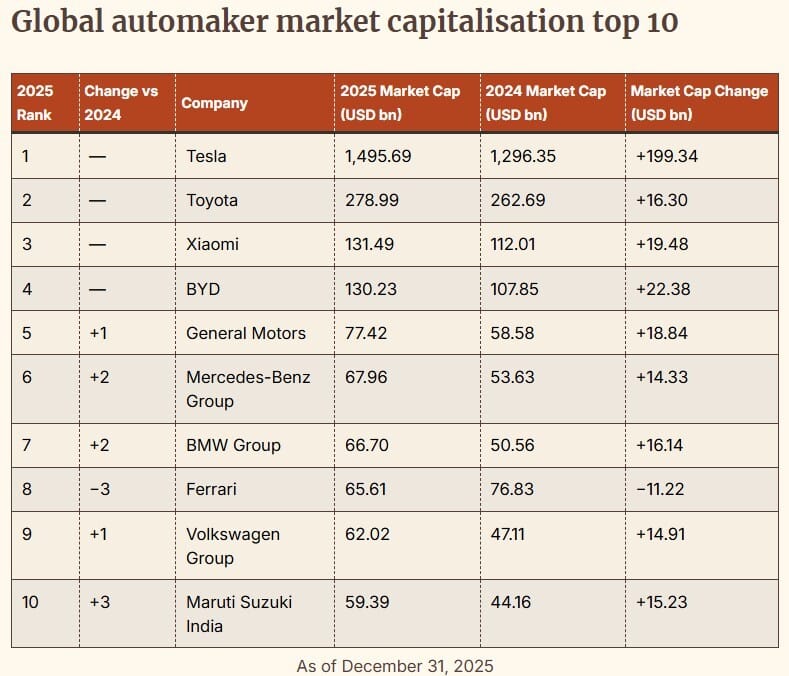
Chongqing and Hefei lead China’s auto production, BYD and Xiaomi rise to top 4 globally by market cap (link, link)
Chongqing led China’s auto production from January to November, with nearly 2.5 million vehicles produced, a 12% year-on-year increase. Hefei ranked first in new energy vehicle (NEV) output, producing 1.2 million units during the same period, up 11%. Anhui Province’s total auto output reached 3.3 million, with NEV production at 1.6 million. Hefei’s industrial strategy has attracted major players including JAC Motors, Nio, Volkswagen Anhui, BYD, and Changan Auto, creating a dense NEV manufacturing hub. Other cities are also rising. Liuzhou, in Guangxi, saw a 38% jump in vehicle output in the first nine months of the year, led by growth in micro electric vehicles.
In 2025, the global carmaker market saw significant shifts with Xiaomi and BYD securing the third and fourth positions in market value rankings, respectively. Tesla led as the largest automaker by market capitalization, followed by Toyota. Notably, Porsche dropped out of the top ten, while BMW, Mercedes-Benz, and Volkswagen moved up. Xiaomi delivered over 410,000, and BYD reported 4.602 million new energy vehicle sales in 2025. Out of the top 50 global automakers by market capitalization, 19 were Chinese companies, with Seres Group at 18th, Great Wall Motor at 20th, SAIC Motor at 21st, Geely Automobile at 22nd, and Chery Automobile at 24th.
The Shanghai Composite Index closed at 4,083.67 on January 6, 2026, marking its highest level since July 2015. The rally was led by insurance stocks, which rose 6.7 percent and 4.2 percent in the first two trading days of the year. New China Life Insurance and China Pacific Insurance hit record highs on both days. The Shenzhen Component Index climbed 1.4 percent to 14,022.55, its highest close since January 2022, while the ChiNext Index rose 0.8 percent to 3,319.29. Goldman Sachs projects continued momentum for China’s stock market, forecasting annual gains of 15 to 20 percent over the next two years, driven by earnings growth and higher valuations. Last year saw strong investor interest in tech stocks, with the Shanghai Composite gaining 18 percent, the Shenzhen Component Index up 30 percent, and the ChiNext Index rising 50 percent.

Chinese firms dominate global 2025 humanoid robot shipments as AgiBot leads with 38% market share (link)
In 2025, Chinese robotics firm AgiBot led global humanoid robot shipments with a 38% market share, shipping 5,168 units. This surpassed major US players like Tesla, which shipped 150 units, holding just 1% of the market. Five other Chinese companies made it into the top 10 list by Omdia, with Unitree Robotics ranking second at 32% market share and 4,200 units shipped. UBTech Robotics, based in Shenzhen, was third with 1,000 units. Total global shipments surged nearly 480% to 13,318 units, projected to reach 2.6 million by 2035. Chinese vendors are setting benchmarks in large-scale production. This growth is attributed to favorable policies, infrastructure support, and investments in both public and private sectors.

AgiBot robot at the 2026 CES trade show in Las Vegas
Reply