- China Insights Weekly | AI, Innovation, Business & Tech in China
- Posts
- Anta Buys Puma Stake 👟 Qwen, Kimi New Models 🧠 35.6 Tesla Magnet 🧲
Anta Buys Puma Stake 👟 Qwen, Kimi New Models 🧠 35.6 Tesla Magnet 🧲
China Insights Weekly for February 2. Unpacking China’s economic and technological advances.


Tomas Kucera & Yereth Jansen
February 02, 2026
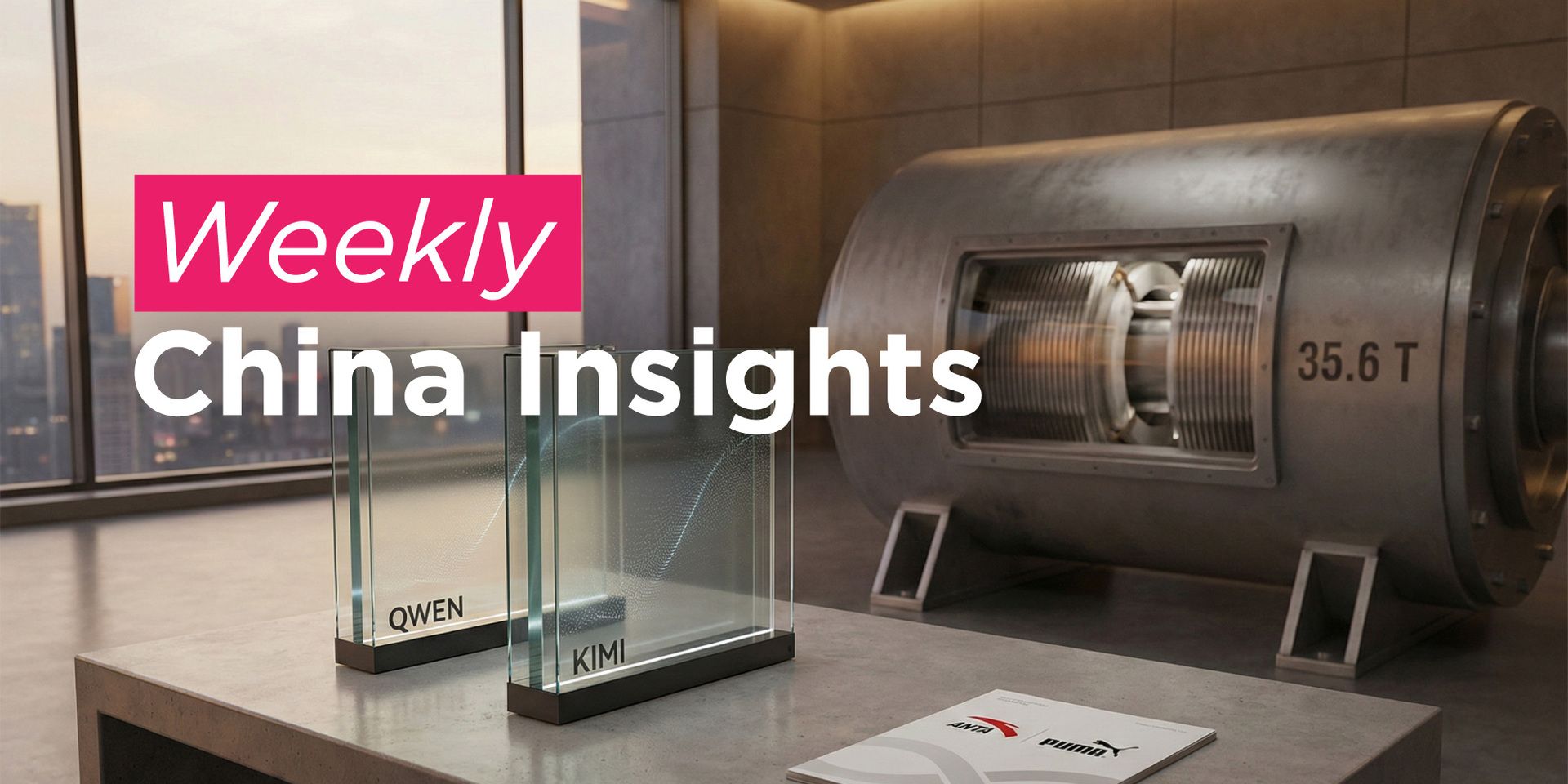
Welcome back to China Insights Weekly. Here are some of the key highlights for this week’s edition:
German investment in China hits a four-year high, firms localize supply chains
AstraZeneca commits USD 15B to China, R&D and cell therapy expand
Inland provinces power export growth, EVs, batteries, solar lead
China becomes net soybean oil exporter again, processing capacity reshapes trade
🚀 Headlines
German corporate investment in China surged to a four-year high in 2025, reaching EUR 7 billion (USD 8 billion) during the January–November period—up 55.5% from EUR 4.5 billion in 2024 and exceeding the EUR 6 billion average recorded between 2010 and 2024, according to IW German Economic Institute data. The acceleration reflects strategic repositioning amid U.S. trade tensions, with Beijing reclaiming its status as Berlin's top trading partner after being overtaken by Washington in 2024. Companies including BASF, Volkswagen, and Infineon are expanding local production capabilities—exemplified by ebm-papst’s EUR 30 million investment accounting for over one-fifth of its total capital expenditure—to build "China-for-China" supply chains that insulate operations from potential tariff disruptions while maintaining access to the world’s largest automotive and chemicals market.
China’s Anta invests USD 1.8 billion in German athletics brand Puma to become its largest shareholder (link)
Chinese sportswear giant Anta Sports Products announced it will invest EUR 1.5 billion (USD 1.8 billion) to acquire a 29 percent stake in German peer Puma from Groupe Artémis, becoming the brand’s largest shareholder while explicitly ruling out a full takeover. The all-cash transaction, funded entirely from internal reserves, is expected to close by year-end, pending regulatory approvals. The deal targets Puma amid operational headwinds. The German sportswear maker posted cumulative losses of EUR 309 million (USD 367 million) through the first three quarters of 2025, with shares having nearly halved over the past year before jumping 17 percent on the news. The acquisition accelerates Anta’s globalization strategy following its 2019 purchase of Amer Sports (owner of Arc’teryx, Salomon, and Wilson) and last year’s USD 290 million acquisition of Jack Wolfskin, supported by 45 to 50 percent retail sales growth across its non-Anta brand portfolio in 2025.

Cambridge, UK-based AstraZeneca announced plans to invest USD 15 billion in China through 2030, significantly expanding manufacturing and R&D capabilities in its second-largest market. The investment targets next-generation modalities, including cell therapy and radioconjugates, building on the 2024 acquisition of Gracell Biotechnologies to make the company the first global biopharma leader with end-to-end cell therapy capabilities in China. Operations will expand across existing manufacturing sites in Wuxi, Taizhou, Qingdao, and Beijing, alongside new facilities, while the workforce will grow beyond 20,000 from its current level of over 17,000. Since 2023, AstraZeneca has signed 16 global licensing agreements with 15 Chinese partners—including AbelZeta, CSPC, and Harbour BioMed—and its Beijing and Shanghai R&D centers collaborate with over 500 clinical hospitals. The initiative aligns with Beijing’s Healthy China 2030 strategy and follows the UK Prime Minister’s recent visit to China.
What should we cover more often? 🗳️ Pick your top choice!Your vote guides our next edition! Choose from the list below. |
China's inland central and western provinces drove 2025 export growth, with nine of the top ten fastest-growing regions located outside coastal manufacturing belts. Xinjiang led with 19.9% foreign trade expansion, followed by Shaanxi (18.5%) and Hubei (18.2%), while growth centered on the "new three" categories—NEVs, lithium batteries, and solar products. Chongqing reported a 73.5% surge in these sectors; Hubei’s lithium battery exports jumped 163%; Henan’s NEV/battery/solar exports hit CNY 33.6 billion (up 1.8x); and Anhui became the first province to export over 1.2 million vehicles annually. Despite this interior shift, coastal provinces including Guangdong, Jiangsu, and Zhejiang maintained value dominance, accounting for CNY 34.1 trillion—more than half of China’s total foreign trade.
China’s Alibaba, Moonshot release flagship AI models, Alibaba and others ramp up AI app race with Spring Festival giveaways (link, link)
Hangzhou-headquartered Alibaba and Beijing-based startup Moonshot AI simultaneously released flagship AI models on January 27, 2026, challenging US market dominance. Moonshot’s Kimi K2.5—a 595-gigabyte open-source multimodal system processing text, image, and video—scored within points of OpenAI, Anthropic, and Google DeepMind in third-party benchmarking while operating over four times cheaper than American counterparts. The model features "agent swarm" capability, enabling up to 100 parallel subagents, though computational constraints limit this to premium users. Moonshot reached a USD 4.3 billion valuation after raising USD 500 million in December from Tencent, Alibaba, and IDG Capital. Alibaba concurrently launched Qwen3-Max-Thinking as its best model so far. US semiconductor export controls have forced Chinese labs toward efficiency-optimized Mixture-of-Experts architectures, yielding high-performance open-source alternatives.
Alibaba Group committed CNY 3 billion (USD 432 million) to a Spring Festival campaign launching February 6, 2026, to drive mass-market adoption of its Qwen AI app across its ecosystem, including Taobao, Shangou, Fliggy, Damai, Amap, and Freshippo. The campaign offers lottery-style free orders and red packets, following rival spending: Tencent allocated CNY 10 billion and Baidu CNY 5 billion for their AI apps, while ByteDance secured an exclusive AI cloud partnership with CCTV’s Spring Festival Gala (February 16).

Jilin has become the second Chinese jurisdiction to exit Beijing’s high-debt-risk list, following Inner Mongolia’s departure in August 2024. Governor Hu Yuting announced the northeastern province’s removal from the roster of 12 high-risk regions, which includes Liaoning, Heilongjiang, Guizhou, Yunnan, and Tianjin, citing 5 percent GDP growth and 13.3 percent growth in general public budget revenue for 2025. The move lifts strict investment controls imposed in 2024 on high-debt jurisdictions and eases local financing constraints. Ningxia submitted its exit application in March 2024, but Jilin secured the second departure, signaling potential fiscal stabilization in China’s northeastern rust belt, while the remaining ten jurisdictions remain subject to borrowing restrictions.

Source: AI-generated, Public Domain Information
Reply