- China Insights Weekly | AI, Innovation, Business & Tech in China
- Posts
- AI Toys Surge 🧸 Robots Clean Streets 🤖 China’s GPU Stocks Soar 📈
AI Toys Surge 🧸 Robots Clean Streets 🤖 China’s GPU Stocks Soar 📈
China Insights Weekly for December 8. Unpacking China’s economic and technological advances.


Tomas Kucera & Yereth Jansen
December 08, 2025

Welcome back to China Insights Weekly. Here are some of the key highlights for this week’s edition:
Beijing and Shanghai extend their lead in global research output across major science fields
Carbios and Wankai to build Asia’s first enzyme-based PET recycling plant in Zhejiang
Kelun-Biotech signs USD 1.3 billion cancer drug deal to advance new oncology therapies
Shanghai creates a state-owned commodities trader to strengthen its pricing power
🚀 Headlines
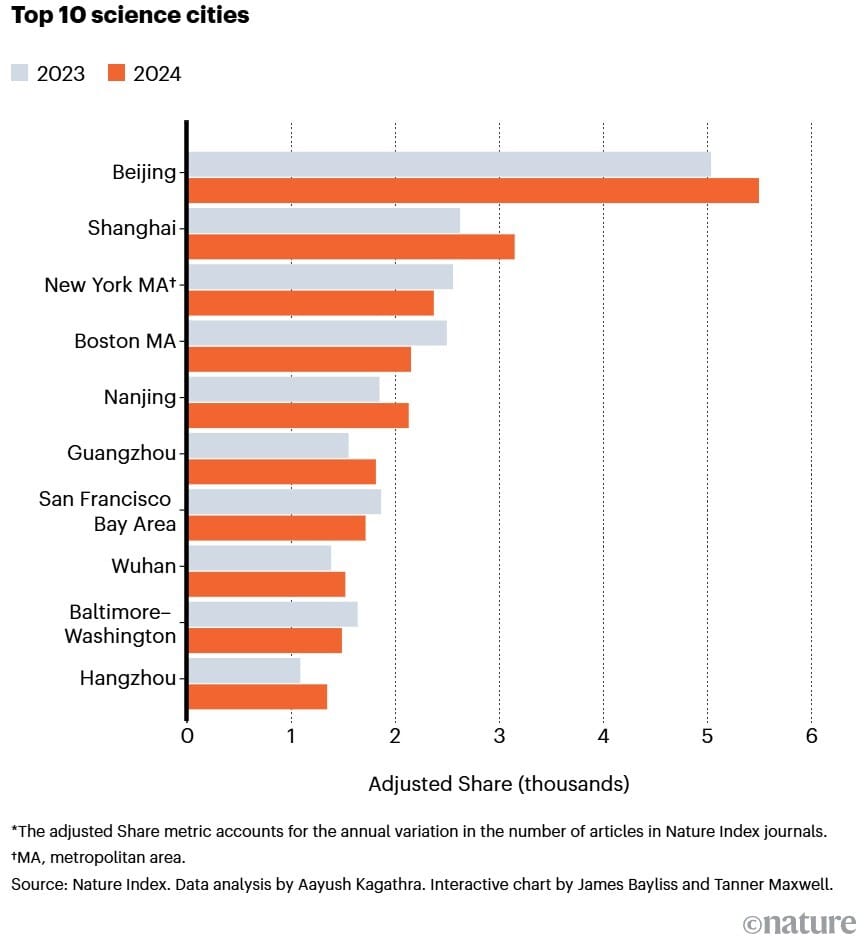
The Chinese cities led by Beijing and Shanghai increase their global lead in high-quality research (link)
According to the Nature Index, Chinese cities are leading in high-quality research output in various scientific fields. In 2024, Beijing's research output, measured by adjusted Share, increased by 9.14% compared to 2023, while Shanghai's grew by 20%. Chinese cities claimed six of the top ten positions in physical sciences, with Beijing maintaining its lead. In biological sciences, Western cities like New York and Boston topped the list, but Beijing ranked third, closely behind Boston. Guangzhou significantly jumped from 13th place in 2023 to 9th place in 2024. In chemistry, Chinese cities dominated the rankings, taking all top ten spots, with Tokyo being the highest non-Chinese city at 12th place. In Earth and environmental sciences, Beijing had more than double the Share of the second-ranked city, Nanjing. Shanghai and Baltimore–Washington each moved up one place, while Wuhan dropped two places.
France's Carbios and China’s Wankai team up to build pioneering PET recycling factory in Asia (link)
France's Carbios S.A. and China's Wankai New Materials are partnering to build a pioneering PET recycling factory in Zhejiang province, China. The EUR 115 million (USD 130 million) facility will be the first large-scale application of enzyme-based degradation technology for waste PET in Asia. The factory aims to process 50,000 tons of waste polyester materials annually, producing high-quality recycled polyester with a low carbon footprint. Wankai will hold 70% of the joint venture (JV) shares, with Carbios holding the remainder. Wankai also plans to invest EUR5 million (USD 5.8 million) in Carbios, becoming a minority shareholder and securing a board seat. The JV will obtain Carbios' exclusive PET decomposition technology license for Asia for three years, convertible to perpetual if capacity reaches one million tons.
When training takes a backseat, your AI programs don't stand a chance.

One of the biggest reasons AI adoption stalls is because teams aren’t properly trained. This AI Training Checklist from You.com highlights common pitfalls and guides you to build a capable, confident team that can make the most out of your AI investment. Set your AI initiatives on the right track.
Massachusetts-based Crescent Biopharma and China's Sichuan Kelun-Biotech have entered into a partnership worth up to $1.25 billion to develop PD-1/VEGF bispecific and antibody-drug conjugate combinations. Under the agreement, Crescent will pay $80 million upfront and promise milestone payments reaching $1.25 billion for rights to Kelun-Biotech's SKB105 outside the Greater China region. Kelun will also receive $20 million upfront from Crescent, plus up to $30 million in milestones and royalties on CR-001 sales inside China. Both companies plan to push their respective therapies, CR-001 and SKB105, into Phase I/II development for solid tumors in early 2026.
Reply